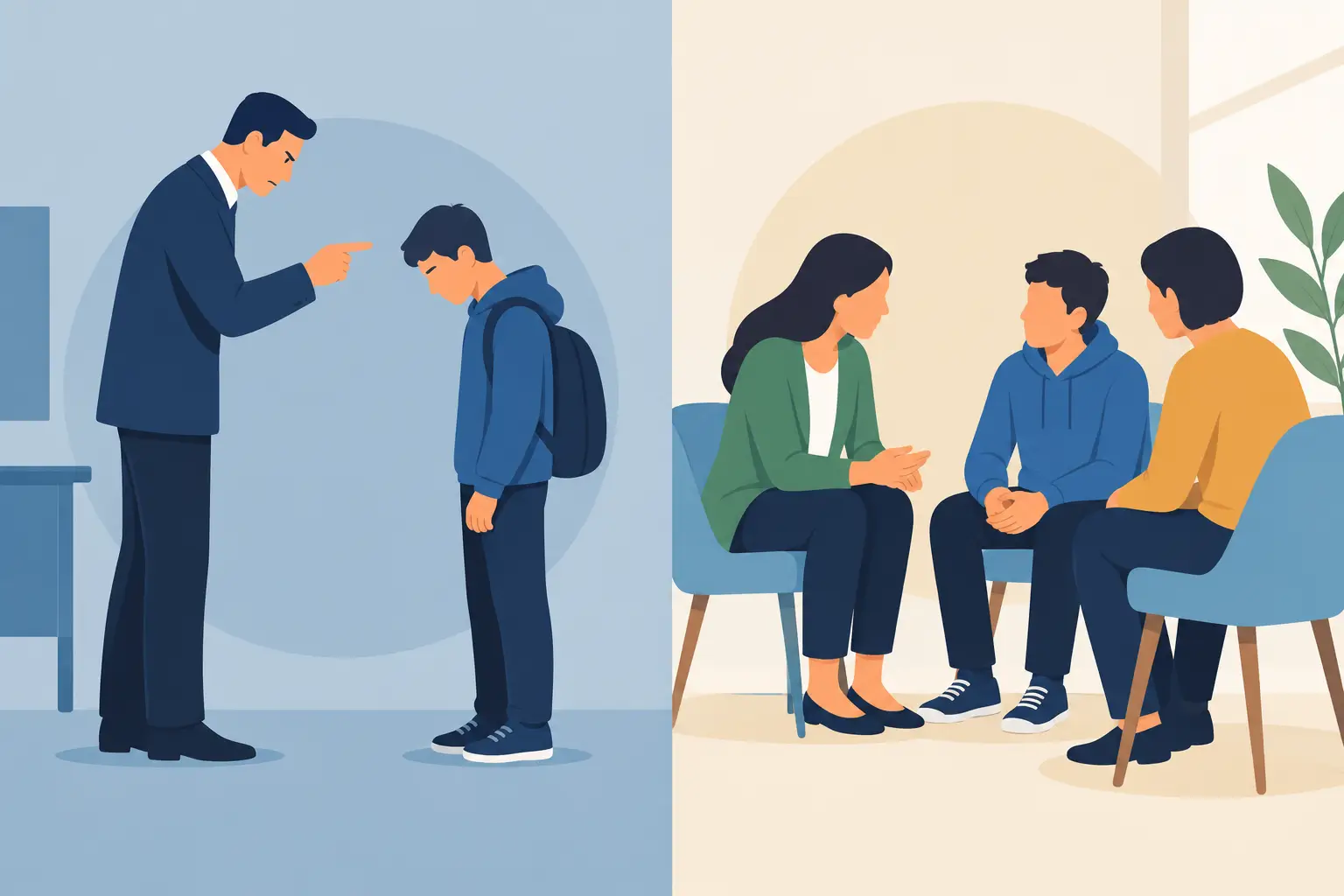
A student reports being harassed in the hallway for weeks. Another student posts cruel comments in a group chat. Families want the school to act immediately, and they should. The hard question is what meaningful action looks like. In the debate over zero tolerance versus restorative discipline, schools do not have to choose between student safety and student growth. They do have to respond clearly, consistently, and with the facts.
Bullying is not a minor conflict to be brushed aside. It can lead to isolation, absenteeism, anxiety, academic disruption, and lasting harm. Every student deserves a school community where they can learn without fearing the bus ride, the cafeteria, the locker room, or the notification on their phone. That requires accountability that protects the student targeted by bullying and addresses the behavior that caused harm.
What zero-tolerance discipline promises
Zero-tolerance policies set predetermined consequences for certain behaviors, often including suspension or expulsion. Their appeal is understandable. When a student has been threatened, assaulted, harassed, or repeatedly targeted, adults need to send an unmistakable message: this behavior is unacceptable.
A clear disciplinary response can also reassure students and families that reporting matters. If students believe nothing will happen, they are less likely to come forward. That silence allows bullying to continue and can make the whole school feel less safe.
There are situations in which removal from a setting is necessary. A student who poses an immediate safety risk may need to be separated from others while the school investigates and determines next steps. Serious violence, credible threats, weapon-related conduct, severe harassment, and repeated behavior after prior interventions may require significant consequences under district policy and state law.
But automatic punishment has limits. It can treat very different situations as if they were identical. It may fail to consider disability-related needs, developmental level, intent, prior incidents, available evidence, or whether a student is also being harmed elsewhere. Exclusion alone can also leave the underlying behavior untouched. A student may return from suspension still angry, still disconnected, and still prepared to target someone else.
Restorative discipline is not “no consequences”
Restorative discipline asks a different set of questions: Who was harmed? What do they need to feel safe and supported? Who is responsible for repairing harm? What must change so the behavior does not continue?
The approach focuses on accountability, relationships, skill-building, and reintegration. It may involve a structured conversation, a written reflection, counseling, behavior supports, restitution, a reentry plan, or a supervised agreement with specific expectations. When used well, restorative work requires the student who caused harm to face the impact of their choices and take concrete steps to make things right.
That is not an easy path or a soft one. Saying “I’m sorry” is not restoration. A meaningful process might require the student to acknowledge specific conduct, stop contact, complete educational work on harassment or bias, participate in counseling, follow a behavior plan, and demonstrate changed behavior over time.
Restorative practices can help schools move beyond punishment as the only tool. They are especially useful for lower-level misconduct, early intervention, peer conflicts without a power imbalance, and situations where students are willing and able to engage safely. They can also strengthen classroom culture before serious harm occurs through community circles, relationship-building, and shared expectations.
Zero tolerance versus restorative discipline: safety comes first
The most responsible answer is often not one model or the other. Schools need a graduated response that matches the severity, pattern, and impact of the behavior.
Restorative processes should never pressure a student who was bullied to meet, forgive, or reconcile with the student who harmed them. They are voluntary for the harmed student. They should not replace a prompt investigation, safety planning, or consequences when those are warranted. And they should not be used to minimize discrimination, sexual harassment, threats, violence, or repeated bullying.
Bullying differs from ordinary peer conflict because it often involves a real or perceived power imbalance and repeated or likely-to-be-repeated harm. Treating bullying as a simple disagreement between two students can burden the targeted student and obscure the responsibility of the student engaging in the behavior.
Before considering a restorative meeting, school staff should determine whether it is safe, appropriate, and desired by the student who experienced harm. Separate conversations are often the right starting point. The targeted student may need schedule changes, trusted-adult check-ins, counseling support, a safe route between classes, help preserving digital evidence, or a clear no-contact plan.
A restorative option may become appropriate later, but only if it supports the harmed student’s needs. It is never a requirement for healing.
Build a response that students can trust
Effective discipline begins before the consequence is selected. Administrators and staff need a reliable process for receiving reports, documenting facts, communicating with families, and following up after the initial response.
First, respond quickly and protect the student’s immediate safety. Let the reporting student know who will follow up and when. Avoid promising absolute confidentiality, since schools may need to investigate, but explain that information will be shared only with people who need to know.
Next, investigate with care. Speak with involved students separately, gather available evidence, review prior reports, and look for patterns. Social media screenshots, witness accounts, staff observations, and attendance changes can all matter. Do not require a student to repeatedly retell a painful experience to multiple adults if the school can avoid it.
Then, make consequences and supports fit the conduct. A first-time hurtful comment and a campaign of targeted harassment should not receive the same response. At the same time, a behavior’s seriousness is not measured only by whether adults witnessed it. Online abuse, slurs, exclusion, rumor-spreading, and retaliation can cause profound harm even when they occur out of view.
Finally, follow through. Check in with the student who was harmed days and weeks later. Monitor retaliation. Confirm that safety plans are working. Work with the student who caused harm on the skills and supports needed to prevent recurrence. Discipline that ends when the paperwork is filed is rarely enough.
What educators and families can do together
Schools are stronger when families know the reporting process before a crisis occurs. Share clear definitions of bullying, harassment, retaliation, and conflict. Explain how the school investigates reports, what information can be shared under student privacy rules, and how families can raise concerns if behavior continues.
Teachers also need practical support. They are often the first adults to notice a student withdrawing, skipping group work, changing routes through school, or becoming unusually quiet. A consistent staff response - interrupt the behavior, document it, report it, and check in - tells students that adults are paying attention.
For parents and caregivers, the goal is to listen without rushing to label every disagreement as bullying or every consequence as unfair. Ask what happened, who was involved, whether there is a pattern, and what would help the child feel safe tomorrow. Save relevant digital evidence and contact the school promptly when there are threats, harassment, discrimination, or ongoing targeting.
Students have a role, too. Bystanders can refuse to amplify cruelty, save evidence, report concerns, sit with a student who has been isolated, and bring a trusted adult into the situation. Small acts of solidarity can interrupt the social reward that keeps bullying going.
Accountability should lead somewhere
A school cannot suspend its way to belonging, and it cannot restore its way around real danger. The strongest approach holds firm boundaries while recognizing that students can learn different ways to handle anger, status, conflict, and harm.
That work takes trained adults, consistent procedures, family partnership, and the courage to center the student who has been harmed. End Bullying Today believes safer schools are built when the entire community moves from concern to action.
When a student asks for help, the response should make one thing clear: you deserve safety, your voice matters, and this community will not look away.